We like books.
We're interested in ways to help more people (especially kids) like books.
You can read more about our company at www.capstonepub.com.
Showing posts with label Michael. Show all posts

Thursday, September 30, 2010

Just Direct Your (Cold) Feet to Monster Street


When I was a first-grader, there was a TV anthology show my parents watched on Sunday nights called Chiller that specialized in Grade-Z monster movies. I was not allowed to join in the fun. I did, however, sometimes sneak down the hall, barefooted, and listen to the roars, screams, sound effects and near-Shakespearean dialogue. Once I listened to a movie called Attack of the 50-ft. Woman. I wondered: How scary, really, is a woman with fifty feet? What could she possibly do? Kick you? Steal your shoes?

I obviously didn’t grasp the reality of the title, but I did make some creative connections of my own. It reminded me that while children may be terrific observers, they are often terrible interpreters. And they need help when it comes to parsing out words with two or more meanings. Or when confronted by those phrases that adults use so easily, yet stumble against a child’s limited vocabulary and experience. Like the idiom “In one ear and out the other.” I used to think grown-ups were discussing flying insects. How about “having cold feet”? Sounds like a Chiller movie about the abominable snowman to me.

I had a lot of fun writing the new picture book series called Monster Street, because it involved making up stories to explain those idioms. And because I could remember how it felt to be confused about words and their tricks and twists. I think my favorite in the series is Two Heads Are Better Than One. I love how the illustrator, Migy, has portrayed the spunky, but sometimes sad, little monster George as he faces life with only one head in a family whose members all sport two. Poor George. Faces life? There’s another idiom. We’re surrounded by them! It’s raining cats and dogs with them! I think of Monster Street as a safe, cozy haven for those young listeners (and readers) like me who were afraid of “another mouth to feed” or the chilling possibility of real butterflies taking up residence in your stomach.

Michael Dahl

Friday, March 26, 2010

Much Ado About Graphic Novels

Ever since 5th grade I have been nuts about William Shakespeare. My teacher, Mrs. Paulson, brought in a readers’ theater version of Macbeth. The story had everything a 10-year old boy could ask for – ghosts, curses, flying daggers, walking trees, swordplay and blood! Our class was transfixed when Mrs. Paulson read Lady Macbeth’s sleepwalking speech: “Out damned spot! Who would have thought the old man had so much blood in him?” The language was a revelation. This Shakespeare guy knew every word in the dictionary, and used them all.

Last week, I had the chance to speak at a conference on literacy held in Stratford-Upon-Avon. It was a dream come true. I spoke to a group of librarians and head teachers (they’d be called principals in the US), about the benefits of graphic novels for younger readers. In Shakespeare’s hometown! I also had the chance to work with some great people, including Joanne Thornhill and Gemma Mason from the Heinemann Raintree office in Oxford just down the road.


It was a busy couple of days. I spoke with dozens of teachers who face the same challenges in the UK that confront educators here in the US – falling test scores, rising illiteracy, a growing apathy toward the written word. Two powerful weapons in their arsenal, however, are high-interest books and graphic novels. That was cheering news to me, since it’s part of the Stone Arch mission to create more such books.


I could not leave Stratford without paying my respects to the man whose work has meant so much to me as a reader and an author. A short walk led from the hotel to Holy Trinity Church where Shakespeare, his wife, and his children are buried just beneath the altar. I feel sheepish saying it was an “altering” experience, but I think Shakespeare would have appreciated the pun.


Wednesday, November 18, 2009

What's Next?

Not since Gutenberg has literacy and the written word gotten so much press. An academy in Massachusetts is throwing out 200,000 books, and replacing them with a coffee shop. A church in North Carolina is burning books, most of them Bibles. The country’s two largest retail chains are waged in a price war over hardcovers. Not electronics, not Tickle-me-Elmo, but books! More digital readers are suddenly on the market. Rupert Murdoch is proposing setting up paywalls to keep Google from “ripping off” his news agency’s content. And Brett Favre is quarterbacking for the Vikings! I know, that last one has nothing to do with publishing, but it’s too cool not to mention. And what’s with all the apocalyptic movies lately? Is this one mass, subconscious metaphor for the revolution that’s taking place in front of our Lasik-reengineered eyeballs? The old world is making way for the new? Burn the Library of Alexandria so we can implant a microchip in your head and thereby save all that real estate for more important things like football stadiums! The point is that the media, like a ship caught in a whirlpool, is circling around the future of print. What will become of books? What will we be reading? Who will be reading?

We are all caught up in the conversation. Here at Stone Arch Books the digital challenge stuck us like a thunderbolt. Which is a good thing. What if -- we wondered -- we put a brand new book, focused on a timely topic, on the web, free of charge? Would this help it get to our readers faster? Beth mentioned yesterday our new Finn Reader, Flu Fighter, a hilarious story told in journal format about a teenager swept up in the H1N1 epidemic. We know kids would love this story. And we know they are curious about H1N1. Running this book through the usual printing channels would take time. Kids want to know now!

What do you think? As lovers of literature, as experts in children’s books, as librarians and media specialists, do you think this is a good method for reaching readers quickly? Have you ever downloaded a free book off the web? Did it give you the same reading experience as reading a bound manuscript? Did it matter? Did you love the story so much that you went back and purchased a hardcopy version to put on your shelves?

As an omnivorous bibliophile myself, I would love to hear what people think. A few times a week I gaze longingly at Amazon’s ads for Kindle, but I still haven’t hit the Buy Now button. My finger is itching. I can’t help it. I love to read, and anything that gets a story into my hands faster can’t be a bad thing. Can it?

Tuesday, August 11, 2009

Superman, meet the kid who saved you.

What better way to cap off a whirlwind of press and excitement than by meeting Superman himself? Our own Joan Berge and Michael Dahl are in New York today, and they're touring the DC Comics offices with our contest winner Hakeem Bennett and his hero, Mr. Brown.

Hakeem and his hero, Matthew Brown. If you look closely, you can see seeing-eye-dog extraordinaire Stanley next to Mr. Brown!

And Stone Arch Books' editorial director and author Michael Dahl couldn't resist getting in on the fun, too! (Those of us who work closely with Michael would expect nothing less.)

Tuesday, June 30, 2009

Is That How You Spell Myers-Briggs?


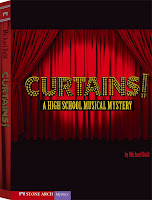
Yesterday I spoke at the Southdale Public Library to a group of parents, kids, and teen library volunteers. I talked about my mysteries and scary stories, including Curtains! and The Book That Dripped Blood. We had a great discussion about monsters, poisons, and Agatha Christie – your basic library discussion when eager young readers are involved, right? Then, a mother of two young boys asked me, “Do you have to be a good speller to write books?” Hmm. I answered that no, you don’t. But -- and this is a big but -- anything you submit to a publisher should be as polished and professional looking as possible.

Weirdly enough, a few days earlier I had been working in my office at home and came across the results of an old Myers-Briggs test that I had taken. Remember, those? They helped you identify the way you processed information or related to those around you? I was labeled as an INFP: introverted, intuitive, feelings-centered, and flexible. In the M-B universe, there are 16 basic personality types. The INFPers, however, are the only ones pegged to make great editors. And that group consists of a mere 1% of the population. In other words, it’s not easy to find a good editor. The publishing industry has known that for years.

Good editors are not simply good spellers. They are good readers and listeners. They are sensitive to the way a character speaks, and how a scene is described. Like a skilled stand-up comedian, they have great timing. They know when and how events should occur on the page. I work with a terrific team of editors at Stone Arch. We have discussions on phrasing, pacing, shifts of tense, if a joke bombs on the page, when to introduce a villain in a story. Yeah, I know, it sounds geeky, but it’s lots of fun. For those of us in that 1% of the population, this is the stuff we dream about at night. We might not have nightmares about poisons or books that drip blood, but we can wake up in a sweat wondering if we used an adverb correctly. Or accurately. Or precisely.

Wednesday, June 24, 2009

Rooster, Owl, and a Little Chicken

Beth is right about how being scared is a matter of perspective, age, and experience. While I was perusing picture books at Wild Rumpus, I was followed by a very curious, and persistent, bantam rooster. I remember being terrified as a child by these creatures when I visited my Great-Uncle Maynard’s farm in southern Minnesota. Of course, now that I have grown taller since then, roosters (or chickens) no longer frighten me, although they still creep me out.

I sat down in an overstuffed chair at the shop, with my arms full of books. The rooster followed. It stood a few feet away and stared at me. Clucking. It could probably smell my fear. (Can poultry smell?) In any case, I tried to distract myself by picking up a paperback reader from a nearby spinner rack. It was Arnold Lobel’s Owl at Home. It was written over 30 years ago, but it was still compelling. Lobel’s stories are simple, appropriate, intriguing, and never condescending. They even have touches of true poetic beauty. I thought of the new Stone Arch Book reader sets we had completed this season, and the impact they will have on our youngest readers. Hopefully, the stories we tell will stay with a child long after they’ve grown and moved on to chapter books and graphic novels. After they’ve outgrown their fears, too. Like beady-eyed roosters.

Friday, June 12, 2009

Spring Weeding

Even on a day off, there’s no getting away from books. Yesterday I volunteered at one of Minneapolis’s inner-city schools. A teacher I know there needed help moving into a new classroom – just across the hall from his old classroom. He taught 4th grade this past year, and next year he’ll be teaching 3rd graders, so he asked me to help him weed his book collection, pulling out anything that might not be appropriate for his younger readers. Weeding is such an intense, personal chore. You’re confronted with dozens of difficult choices with each book you pick up. And just because I love a particular book – for example, he had a copy of Rumer Godden’s exquisite The Mousewife – doesn’t mean 3rd graders will share my enthusiasm. Now I know what librarians have to go through. My friend had bought most of those books himself over the years. Many of the books were tattered, had ripped covers, or had handwriting scrawled on them. They had been touched and opened and read by hundreds of little hands. These were books that had become part of children’s lives, at least during those hours they spent in my friend’s classroom. These books meant something to all of us – to the students, to my generous friend, and finally to me, who had to choose what to keep and what to discard. The Mousewife is now sitting on a shelf in my bedroom.

Tuesday, May 19, 2009

9 THINGS I LOVED ABOUT IRA (A countdown to a reading explosion!)

9. Words, words, words
Being a logophile and lover of books since elementary school, I enjoy being around words and those who like words – readers, writers, critics, fans. And I get jazzed whenever I’m with a group of people who are as concerned and connected with literacy as the IRA crowd. Sitting at one of the convention cafes with a hot chocolate or walking through the exhibit hall, overhearing bytes of conversations about kids and reading and “reading assessment” and “instructional strategies” made me realize at once that I had found my people.

8. Sign Time
On the third day of the conference I had the opportunity to autograph books at the Red Brick Learning booth. Red Brick is the classroom division of Capstone Publishers, so it was a natural fit for me to sign there and meet with those teachers who actually use my books in the classroom. What a thrill to hear about kids getting excited about the Library of Doom, or one of my Superman stories, or even the book I wrote for Picture Window, If You Were A Palindrome. (I always wished I had one of those names that was a palindrome, like Bob or Otto!)


7. The Red Brick booth
The booth looked great! Colorful book covers, eye-popping posters hanging against the black backdrop, and cool videos playing on a monitor.


6. Jon Scieszka
Yes! I was able to meet him – the Ambassador of Books for Boys. He is one of my all-time heroes. A funny, humble, and creative guy who never stops inspiring people to read and to write. And I like his hairstylist. In fact, I think he and I have the same one.


5. The Food.
Just kidding. Although I did share a lunch outdoors with Joan Berge, the president of Capstone Fiction, on one of those glorious spring Minnesota afternoons. Azure sky, puffy clouds, bright sunshine, and a humidity-free 70 degrees. Like a day at the lake, right?

4. Standing Room Only
I co-presented a workshop on graphic novels in the classroom with Dr. Stephen Sargent from Northeastern State University in Oklahoma. Stephan is a brilliant professor of reading and literacy and was a great partner to work with (and had some excellent hand-outs, btw). The two of us had been told to expect between 25 and 30 participants. We had 72! The graphic wave continues to roll!
And I received great feedback on some of our Graphic Revolve retellings, like Swiss Family Robinson. It’s amazing how a even single illustration can provoke so much thought and delight and discussion!
3. Swag
Lots of free posters, banners, books, bookmarks, and giveaways. I had fun handing out our Stone Arch DC Superhero poster and the one on the Power of Reading. The graphic of the four Recon Academy teen heroes looks appropriately high-tech and tough.

2. Invisible Creatures
The one major element of the crowd that you couldn’t see, but definitely made their presence known each day – the kids! That’s why we were all there. To get kids reading better, reading more, and reading for pleasure. There was enough energy and creativity at the Minneapolis IRA conference to explode in a cloud of literacy that would cover the country. I think it’s begun.

1. Blast off!

--Michael Dahl
Editorial Director

Monday, April 13, 2009

Four Most Powerful Words

TLA was simply amazing! Those aren’t the four most powerful words. But they come close. The Texas Library Association is a great chance for those of us who spend most of our life at quiet desks, tinkering with nouns and verbs, to meet the people who give life to books by connecting them with kids and readers. Librarians and media specialists are the best conversationalists you’ll ever meet. And I had some great conversations.

I talked with a woman who said she was finally able to raise a young student’s test scores because the girl became an enthusiastic reader of our Library of Doom series. In fact, the girl brought four of her friends into the school library to turn them on to the books too.

One media specialist thanked me because the Stone Arch books were the only books that one of her problem boy readers would pick up . . . and finish!

Joan Berge, the president of Stone Arch Books, Heather Kindseth, the creative director, and I hosted a breakfast focus group with a dozen librarians.1 We discussed everything from scary books to comic superheroes to the popularity of the Twilight series. 2

One day on the exhibit floor, scores of high-school students were roving in nomadic bands, hunting for advance copies and posters and fun giveaways3. It was fun to talk about graphic novels as well as traditional novels with these young people. They were so passionate about their favorite books.

The welcoming and literate and diverse crowd at the conference reminded me of my first introduction to Texas hospitality, when I worked at the Renaissance Festival outside Magnolia, Texas a number of years ago. I was part of a wandering troupe of players that would improvise stories yelled out from the crowd – “Rapunzel! Jason and the Golden Fleece! Cinderella! Ben Hur!4”

It seems every time I’m in Texas I’m either telling a story or hearing one. I heard some great stories and anecdotes from the media professionals about the stories that our authors tell in our books. It was like a powerful chain reaction of literacy, or a massive Southern oak sprouting from a seedling. Oh, and those four most powerful words – tell me a story. Thanks to all the people who told me their stories in Houston this year.

Michael Dahl
Editorial Director


1 Why don’t they serve biscuits and gravy up here in Minneapolis? Yum!

2 Several librarians said that their girl patrons loved the books not because of the romance between Bella and Edward, but because of the vampires. Vampires, it seems, never lose their cool quotient.

3 We literally had girls (and boys!) screaming with excitement over our lenticular Superman/Batman bookmarks. I have to admit, they do look cool.

4 Uh, yes, one afternoon we improvised a version of Ben Hur. Complete with a chariot race and a sea battle of Roman warships.

Monday, March 2, 2009

Giving Birth to Dragons

Where do dragons come from? Easy. From eggs. But where do ideas come from? Not so easy.
Last year, I wrote a series for Stone Arch called The Library of Doom, a dark, fantastical, monster-filled set where the hero is called The Librarian. The books were well-received, and I was encouraged to write another series for the same reader: a kid who struggled with vocabulary, most likely a boy, who was into pop culture, but was also probably embarrassed by not reading at-level.

So, I first thought about a sci-fi setting: two boys in the future who crash-land on an uncharted, unexplored, gigantic planet. This would give the boys lots of room to explore and encounter all kinds of aliens and adventure. I even wrote a few manuscripts along these lines, but they just sort of lay there on the page. Flat. There was no spark. I realized that a planet, no matter how huge, was still basically one setting. Just like the Library of Doom. Authors like to give themselves challenges, try out new tricks, and I wanted this series to be different from the Library: lots of heroes, lots of locations.

And that’s when it gets harder to explain. As I pictured that gigantic planet, I saw the image for the TV series Heroes, which is a view of the Earth from outer space. Heroes? Hmmm. What about a series where kids (rather than adults) all over the world discover that they are different from ordinary human beings? They don’t possess traditional super powers, they possess . . . what? And from some forgotten, rarely visited fissure of my brain, another image popped up: dragons. I’ve loved dragons ever since elementary school – the dragon Smaug from Tolkien’s The Hobbit; the legend of St. George; and, of course, the monstrous serpents of Greek mythology like the one killed by Apollo, or the Hydra with seven heads, or those terrible papier-mache creatures from the 60s sword-and-sandals flick The Fire Monsters Against the Son of Hercules (I was a mythology nut as a kid. In 5th grade, I even built an altar to Apollo!).

Somehow, both of those images collided and gave me the idea for Dragonblood. Six books came out last year, and I’m writing six more. And as I work on these new ones, something else has joined the mix. I can see how the young heroes coming to terms with their bizarre genetic gift of dragon blood (and wings and scales and talons), is not all that different from kids coming to terms with adolescence, becoming human, growing up. So these three ideas, brooding quietly in their neuron nest, decided to hatch and come twisting like a lizard’s tail from the corners of imagination and past history to become a book.

So where do ideas come from? Maybe the answer is eggs.


Michael Dahl
Editorial Director
SAB

Monday, January 12, 2009

Is Superman Dead?

When I was 8 years old, I purchased a 12-cent (!) DC comic with the book-length story “The Last Days of Superman.” This was not the amazing graphic-novel blockbuster of 1992, but the earlier Superman, issue 156, October 1962. I must have read that story about 35 times, weeping during the first 20. Of course, Superman didn’t die. How could he? Superman is invincible (except for kryptonite, but that’s not the point).

I thought of that story when I read a recent article in the December issue of School Library Journal. It was titled “Wanted: Male Models” and lamented the lack of male reading models for young children, especially for boys. We definitely need more men to read to their children, to spend more time curled up with a book rather than with a warm TV set or computer monitor. I agree with the writer —we need more male mentors. But I have seen them, and it’s usually at a comic book shop or in the graphic novel section at the local big-chain bookstore.

Wednesday is “new comic book” day across the country. Several of us from the Stone Arch office often visit one of our favorite comic book stores in the middle of the week, either to browse or to get that special issue we’ve been itching for. (For me, it was the new Metal Men by DC artist Duncan Rouleau.) Often, we see other guys there with their kids, all gazing at shiny new covers or vintage editions wrapped in protective plastic.

I frequent another comic shop in downtown Minneapolis, usually on the weekends. I always see dads, and often moms, accompanied by their bright-eyed kids, all of them excited and talking about some new manga adventure or superhero tale. The male models are out there. They are reading, although they may not be in the library. Yet.

Which, I guess, answers the question I posed at the beginning of this posting. Superman isn’t dead. He has a growing horde of new fans. And that makes me hopeful—about reading in general, and in particular, about the imaginations of the young. It also thrills me to partner with DC Comics in our new Super Hero line of original stories about Batman and Superman. This could pull back into the library some of those kids who were looking for their favorite reading material elsewhere. And for me to help create books with the same people who gripped me with their caped crusaders when I was 8 years old . . . wow!

Pastimes and hobbies and ways of spending time will change over the years, but we’ll always need stories. Kids are still reading about superheroes. Maybe they’re hidden in the back corner of a comic book store, or behind a spinner rack blooming with manga, but they are there, and they’re very much alive.


Michael Dahl
Editorial Director, Stone Arch Books

Wednesday, October 29, 2008

Stone Arch Books on TV!

Our very own Michael Dahl was interviewed for a CBS news story on getting boys to read. The story aired Monday night on CBS in Austin, Texas.

You can read an article and see part of the interview here!

And let us know: how do YOU get boys to read?

Wednesday, May 14, 2008

Sooner (or Later) Kids Love Books!

Kids are wild about reading down in the Sooner State. I recently returned from a trip to Tulsa, Oklahoma where I spoke at the Young Author’s Conference, the Tulsa Reading Council, and made a few school visits. On Saturday, the young authors surprised me. Whether in first grade or fifth grade, they all liked scary stories! And they all loved graphic novels. I showed the artwork and read from my Library of Doom series. They wanted more! After the workshops, the conference sold books written by the participating authors. Kids snapped up 5 or 6 books apiece of the Doom books. “Which one’s the scariest?” they would ask.

On Monday night, before the Reading Council dinner, I spoke with a number of educators and librarians whose students had been at the conference Saturday. One woman told me that one of her boys, Justin, who was not a reader at all, had his nose buried in a book at the back of her class. It was one of the Library of Doom books, The Book That Dripped Blood. He was supposed to be writing in his journal. So when the teacher walked over to his desk to remind him, Justin looked up, pleading, and said, “But I just have to finish this first!” And she let him.

As an author, that’s about the best praise I can get—the knowledge that my books have done just what I (and the rest of the staff at Stone Arch) intended them to. They’re not just creating spooky atmospheres—they’re creating environments of reading success.


--Michael Dahl
Editorial Director, Stone Arch Books

Wednesday, April 23, 2008

TLA: Flying Off the Shelves

We kept hearing throughout the Texas Library Association conference that our books fly off of library shelves, but we’d never seen it in action. Until, that is, the last day of the conference. It was the wildest, most fun day. That’s when – at the stroke of 11:00 AM – the Stone Arch Books booth began to give away books. No, not sell them at a discount, like most of the other publishers at the conference. Ours were free! But only if a person could get at them in time. The madness began several hours before 11, when librarians walked through our booth, checking out titles, examining the art and the back matter, and spotting the best books to fill their collections. Then, as soon as the clock struck 11, the booth looked like a Lord & Taylor white sale. Librarians everywhere. Books flying off the shelves. And the coolest part of this amazing bibliophilic chaos is that the librarians are not doing this for themselves. These books are for their kids. That’s one of the reasons I love this business. The adults I work with all have the same focus, the same passion, the same goal – we want kids to read and have fun reading! We know it will only enhance their lives. So the more books we can get in their hands, the better.


--Michael Dahl
Editorial Director, Stone Arch Books

Thursday, April 3, 2008

GUYS READ – IT’S UNSTOPPABLE!

Jon Scieszka has created a monster—a joyful, galumphing juggernaut called Guys Read. Ever since he launched his website, Scieszka has inspired teachers and librarians across the country to start their own Guys Read programs. On March 25th I was able to attend an all-day workshop on Scieszka’s brainchild, hosted by the Hennepin County Libraries and Stone Arch Books as part of the PLA preconference. The workshop couldn’t have been better organized. After Scieszka gave the opening remarks, we heard from public policy makers, politicians, lawyers, public librarians, mentors, fund-raisers, and parents of Guys Read programs from around the US. Their message was clear, focused, and overwhelming: Guys Read is a success. Boys want to read and will read if given the right material.

Scieszka warned us that we need to learn the language of boys. Boys think differently than the majority of librarians (whom he characterized as predominantly female and mostly middle-aged). One female librarian echoed Scieszka from her own experience, saying she had learned what not to say to a boys’ reading club. “Never ask them how they felt about the story,” she cautioned. “A lot of young boys don’t know how they feel about anything. Instead, ask them what they would have done if they had been in the story.” Boys prefer the hands-on, feet-on, jump-on approach. One librarian said his boys’ group created rituals to start and end each meeting. They have a march and a chant, and carry a flag created by one of the boys’ moms. Another club leader said he sometimes spends half the time playing football with his readers. The point is to make a Guys Read group fun, to teach boys to associate books and reading with pleasure and excitement. “This is not school,” says Scieszka. “There are no quizzes, no questions, no grades.” We also heard the responses from parents and grandparents, how reading had changed the lives of their boys.

During one of the breaks from the workshop, I wandered over to the chaotic PLA exhibit hall where the booths were being assembled, including ours. I visited with Heather Kindseth, Stone Arch Books’s creative director. As we talked, Jon Scieszka walked down our aisle. I stopped him and told him how much I enjoyed his books. Just an hour earlier he had mentioned that when thinking about books for boys, he paid attention to two things: the spine couldn’t be too thick, and the cover had to be eye-grabbing. He said he could tell, just by looking at the Stone Arch books, that we were on to something. “This is exactly what boys will want to pick up and read,” he said. Then he asked for one of our catalogs.

Scieszka has been made the first National Ambassador of Young People’s Literature by the Library of Congress. Spend a minute with him and you’ll know why. He’s approachable, he’s smart, he’s funny, and he’s passionate about getting kids to read. And Guys Read is an idea that anyone with an interest in boys and books can get behind. You can’t stop it. As Dr. Frankenstein said about another literary monster: “It’s alive!”


--Michael Dahl
Editorial Director, Stone Arch Books

Tuesday, March 18, 2008

On oral language

Oral language -- language that is similar to the way kids speak and hear it -- is vital in fiction books for struggling readers. According to Kylene Beers’s book When Kids Can’t Read What Teachers Can Do, “fragments, run-ons, short sentences, and slang all help create what readers call ‘real talk’ or ‘slang lang’ in a book.” This is the language kids hear in their heads. When this type of language is used in a book, it becomes easier for them to relate to the text on the written page.

This is something the editors at Stone Arch Books are constantly thinking about. We want our characters to sound real. Characters who speak with words and phrases appropriate to the situation, and are contemporary without being too trendy, help the reluctant reader enjoy the story. No kid wants to read about a hero who sounds like a grammar textbook. Bullies should sound mean, not literate. We take care to make our books sound the way kids talk, paying close attention to things like contractions, limited narrative passages, lots of dialogue, and sentences ending in propositions. They’re not always a part of exceptional literature, but they help students get into reading and eventually transition into more difficult literature.

In short, oral language gets kids reading. Specific elements of oral language, however, need to be kept to a minimum, or sometimes even deleted, to aid the struggling student. These include figurative, or flowery language, unnecessary use of idioms, homophones, and homographs. Whatever is not a part of a kid’s natural speech habits needs to be introduced in small and deliberate doses.

This approach extends a helping hand and gently moves the reader from oral language to the basics of written language, and then upward to more complex and more engaging material. No one will read Hamlet unless they can first get excited about ghosts, graveyards, and swordplay. And no one can get excited about ghosts, graveyards, and swordplay unless they are given the material in words that are familiar. At Stone Arch Books, we want to get kids excited about reading. To do so, we take time to make sure that our books echo kids’ words as well as their world.


--Michael Dahl
Editorial Director, Stone Arch Books

Wednesday, February 13, 2008

Boys, Books, Firetrucks, and SCBWI

The New York Fire Department made an unexpected guest appearance last week at the 9th Annual Winter Conference of the Society of Children’s Book Writers and Illustrators (SCBWI). Their visit was brief, thankfully. Saturday morning, as most of the guests and speakers were in their respective showers, the hotel’s fire alarms went off. A small blaze had started in a laundry chute. The fire was quickly put out; the alarms were switched off. In her opening remarks, Executive Director Lin Oliver explained the situation to the attendees and gleefully enjoyed crying “Fire in the Chute!” She said it had always been part of her “boy fantasy” to say those words.

Too bad there weren’t more words given over to boy fantasies, or mysteries, or adventures. The 1000+ crowd included only 160 men. This may not be an accurate reflection of the overall industry, but it made me think. Last year’s conference was all abuzz with “books for boys.” All the major trade houses had talked up their commitment to bring out more titles and series for the young male reader. But this year, the buzz was gone. The excitement was switched off.

Yes, there are a few more books out there with boy heroes and boy topics, but the big houses are concentrating on girls. Again. I guess they realize that’s where their biggest market is. Why not boys? Why not give every kid an adventure that can be found only on the written page? I want to create books that the reluctant boy reader will grab and devour. I don’t think of this as simply a trend, or something the team at Stone Arch Books will do just this year. It’s a daily preoccupation in our office. Sparking a boy’s imagination, firing up his curiosity, feeding the burning need for adventure and heroics. Fire in the chute!


--Michael Dahl
Editorial Director, Stone Arch Books

Thursday, February 7, 2008

Networking in New York

New York will be in a good mood when I arrive this afternoon – an afterglow of congeniality from the Giants’ Super Bowl lightning-bolt win. Of course, there’s always a feeling of camaraderie at the SCBWI (Society of Children’s Book Writers and Illustrators) conference. SCBWI is an international professional organization that promotes knowledge among authors, illustrators, publishers, agents, educators, and booksellers who are passionate about children’s books. It’s the ideal networking opportunity for people who are already a part of this industry, as well as those who want to join in. I look forward to their annual winter conference each year; it’s a great place to meet enthusiastic and talented authors and artists. That’s where I met Lisa Trumbauer. Her book A Practical Guide to Dragons had just topped the NY Times bestseller list. She went on to write one of our first sports books for girls, Storm Surfer. And now she’s working with us on another project for Spring ‘09.

Last year’s conference brought together three of the biggest names in children’s literature: Katherine Paterson, Susan Cooper, and Brian Selznick. It was an alignment of the heavenly bodies. This year’s opening address will be given by poet Nikki Grimes. Wow! And Richard Peck, one of my favorite authors, will be there, along with Susan Patron (Newbery Award-winning author of The Higher Power of Lucky) and David Wiesner (Caldecott Medal-winning author/illustrator of Flotsam).

I’m also excited to hear from some equally influential stars on the business side of the industry. David Gale, Vice President/Editorial Director at Simon & Schuster Books for Young Readers, and Mark McVeigh, the Editorial Director at Aladdin Paperbacks, will be heading up breakout sessions. I’ve signed up for both of them. When I return to the office, I know that my laptop will be reaching its megabyte limit with new names and addresses of potential authors and illustrators for Stone Arch Books, as well as info on the hottest industry trends, the latest technology, the changing profile of young readers, and the delight and challenge that all the participants share in the ageless art of storytelling.


--Michael Dahl
Editorial Director, Stone Arch Books

Monday, January 28, 2008

Staff Spotlight: Michael Dahl

Name: Michael Dahl

Occupation/role at Stone Arch Books: Editorial Director and Acquisitions. I oversee all the editorial operations at Stone Arch, including list planning, story development, and working closely with the editors. I also handle submissions from new authors, acquire manuscripts, and manage freelancers. I’m also the author of the Library of Doom series.

Years at Stone Arch Books: I joined Stone Arch a few months after it began, in 2005.

Education: I went to school at Augsburg College and the University of Minnesota, graduating with a BA in English Literature and Theater.

What's your favorite SAB book?
There are so many! I guess my favorite graphic novel (so far) is Journey to the Center of the Earth. I’ve loved Jules Verne since I was in 4th grade. The art for this book is fantastic; the sea monsters are truly awe-inspiring. My favorite high-interest novel is Spies, a David Mortimore Baxter book. David is such a charming, likable, and real kid, and this particular story is funny and serious and smart all at the same time.

What was your favorite book when you were a kid?
I read constantly as a kid. I even read the dictionary – for fun. Yes, I was that nerdy kid in class who knew the difference between entomology and etymology. Bugs and words, two of my favorite subjects at the time. I was also a big fan of Edgar Rice Burroughs, J.R.R. Tolkien, and Pilgrim's Progress. But the book that made the biggest impact on me when I was in 5th grade, and beyond, was Agatha Christie’s And Then There Were None. She had me spellbound until the very last page. She was a genius.

What were you like as an elementary/middle-school student?
I was the bookworm. More like the book fanatic. Whenever I did a book report, I wrote it in the style of the book’s author. My teachers told me that I didn’t need to “embellish.” I really went overboard when I gave a presentation to the class on a book about ancient Egypt and asked for volunteers to be mummies.

What's your favorite thing to do in your free time?
Besides reading, you mean, right? Visiting graveyards and haunted houses. It’s an activity that combines history, biography, geography, the unexplained, and heaps of fresh air.

Tell us a memorable Stone Arch Books moment from the past year.
I was fortunate enough to speak at the EncycloMedia conference in Oklahoma City this past fall. I gave a presentation on graphic novels and how teachers can use them to get kids excited about reading and increase their comprehension skills. I was amazed when I walked into my room several minutes before the talk and found it was standing room only. It was a great audience. And afterwards, dozens of teachers and librarians told me that they had never considered adding graphic novels to their collections until they had attended that workshop. It was gratifying to be able to show people what an incredible new art form (and teaching tool) graphic novels have become.

What’s the best part of your job?
Working with a team of talented, creative people. I love brainstorming, collaborating with smart, enthusiastic editors, designers, authors, and illustrators, and creating something that we couldn’t do separately as individuals.

What’s the hardest part of your job?
Working with a team of talented, creative people.


This is the first in a multi-part series, which will spotlight the members of the Stone Arch Books staff. Drawing of Michael Dahl by Brann Garvey.

Tuesday, January 15, 2008

Hugo Cabret: The Shape of Things to Come?

Last year at the SCBWI conference in New York, I was in the audience when Brian Selznick presented his amazing The Invention of Hugo Cabret, a Novel in Words and Pictures. He first spoke about how he was inspired by silent films, especially those created by the Lumiere brothers of France. Then he showed a nonstop montage of images from Hugo (lasting at least 20 minutes) accompanied by atmospheric orchestral music and, of course, ending with a famous shot of the David O. Selznick mansion, which featured in the credits of many Hollywood classic films (the director is a cousin of Brian’s grandfather). When the “film” was over, there was a collective gasp, and then a standing ovation.

Graphic novels today seem to take most of their inspiration from current mainstream cinematic effects. Selznick showed his audience that any powerful visual medium can spark and trigger an idea, a plotline, a character, or a scene. That’s one of the reasons I was thrilled to hear that Hugo won the Caldecott: Selznick has redefined the novel that tells its story “in words and pictures.” At Stone Arch Books we have two copies of Selznick’s 20-pound tome on our shelves, one for Design and one for Editorial. Hugo makes us look at all of the art that surrounds us on a daily basis, and re-think how it can help us make our books more exciting and more affecting, and speak to reluctant readers in ways we never thought possible.


--Michael Dahl
Editorial Director, Stone Arch Books